
7 Best AI Email Marketing Tools in 2026

Here’s something most marketing blogs won’t admit. Half the people reading about email marketing tools are doing so because their current setup is quietly failing them. Open rates are dropping. Automations that made sense two years ago now fire at the wrong people at the wrong time. A growing list that somehow generates less revenue…

Zannatun Nime
Here’s something most marketing blogs won’t admit. Half the people reading about email marketing tools are doing so because their current setup is quietly failing them.
Open rates are dropping. Automations that made sense two years ago now fire at the wrong people at the wrong time.
A growing list that somehow generates less revenue than it did when it was smaller.
Sound familiar? You’re not alone, and it’s not your fault either.
Email marketing has gotten genuinely complicated, and the old “set it and forget it” playbook just doesn’t hold up anymore.
That’s the gap AI email marketing tools were built to fill. Not to replace what you’re doing, but to make the decisions your current system can’t.
Things like figuring out which subscriber is three days away from churning, or knowing that a specific customer converts better when they get an email on Thursday evening rather than Monday morning.
These aren’t things you can reasonably figure out manually across a list of thousands of people.
This guide is for anyone who’s tired of guessing.
We’ve gone through the noise and picked seven AI email marketing tools that actually deliver in 2026, covering what each one does well, where it falls short, and who it makes the most sense for. No fluff, no filler.
What is AI email marketing used for?
AI in email marketing goes way beyond auto-generating subject lines (though it does that too). Here’s what it actually handles in the real world:
Audience segmentation: AI groups your subscribers based on behavior, purchase history, and engagement patterns, not just the list they signed up for.
Send time optimization: Instead of blasting everyone at 9 am Tuesday and hoping for the best, AI figures out when each individual subscriber is most likely to open.
Personalized content: Dynamic content blocks that change based on who’s reading. Someone in Dhaka sees something different from someone in New York, even from the same campaign.
Predictive analytics: AI estimates which customers are likely to buy again, who’s about to churn, and where your revenue is hiding.
A/B testing at scale: No more manually setting up split tests. AI runs experiments automatically and shifts traffic toward the winner.
Workflow automation: From welcome sequences to cart abandonment emails, AI builds and adjusts flows based on what’s actually working.
Best AI Email Marketing Tools at a Glance
| Name | Best For | Free trial | Starting price |
| Klaviyo | eCommerce brands | Free up to 250 contacts | $20/month |
| Mailchimp | Beginners and small businesses | Free plan available | $13/month |
| ActiveCampaign | B2B and SaaS funnels | 14-day free trial | $15/month |
| GetResponse | All-in-one marketing teams | Free plan available | $19/month |
| Omnisend | SMB eCommerce stores | Free plan available | $16/month |
| Brevo | High-volume senders | Free plan available | $25/month |
| ConvertKit (Kit) | Creators and solopreneurs | Free up to 1,000 subscribers | $29/month |
Top AI Marketing Tools in 2026
1. Klaviyo
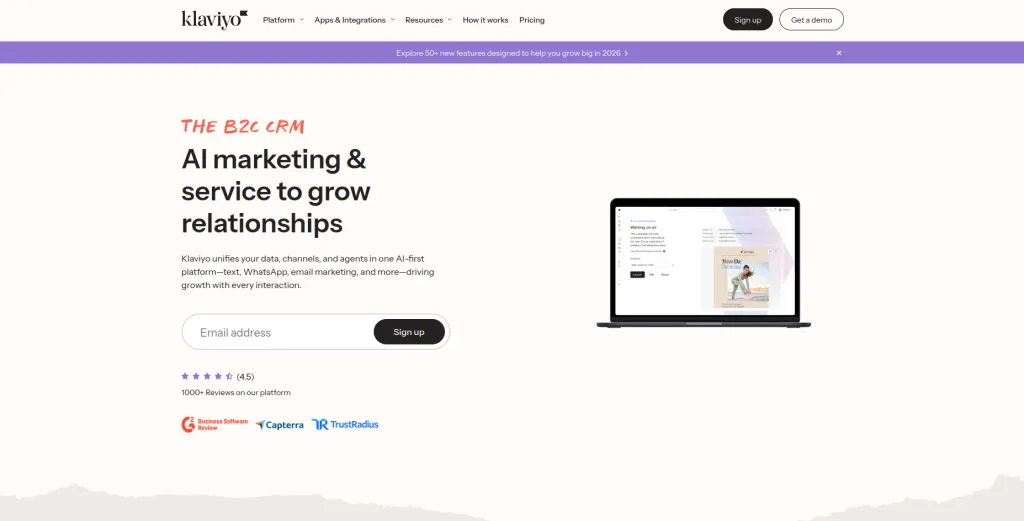
Klaviyo is genuinely the gold standard for e-commerce email marketing right now. It was built around real-time customer data, which means every product view, cart action, and purchase feeds directly into how it makes decisions.
It’s not just sending emails. It’s running predictions based on what your customers actually do.
Key Features:
- Predictive customer lifetime value
- Churn risk scoring
- Natural language segmentation
- AI-powered send time optimization
- Product recommendation engine
- Pre-built eCommerce automation flows
- Real-time revenue tracking
Pros and Cons:
| Pros | Cons |
|
|
Best For: DTC brands, subscription businesses, and eCommerce stores with a decent volume of repeat customers.
Pricing Plan:
Free plan up to 250 contacts. Email plans start around $20/month for 500 contacts. Pricing scales with list size, so large senders should budget carefully.
2. MailChimp
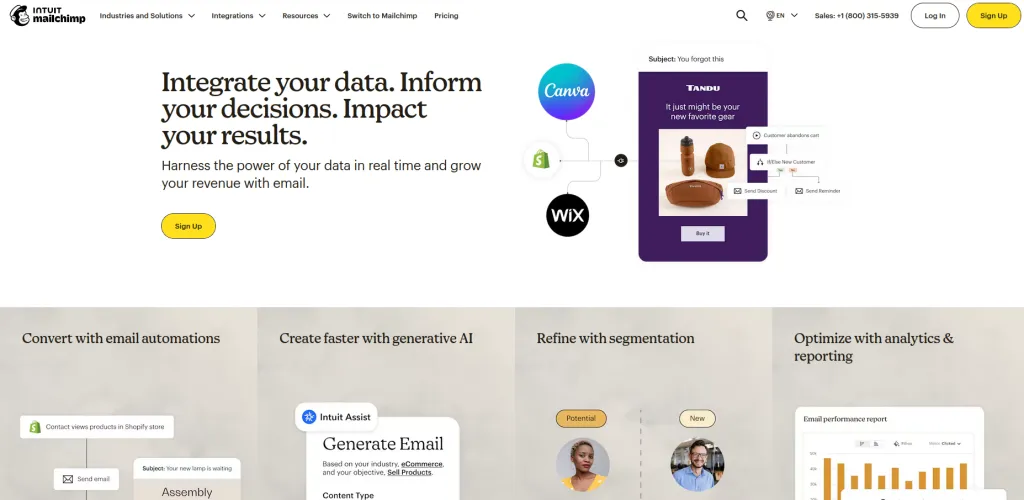
Mailchimp has been around long enough that most people have used it at some point, even accidentally. But what many people do not realize is how much the platform has evolved.
The AI features added over the last couple of years have turned it from a simple newsletter tool into something genuinely useful for growing businesses.
Key Features:
- AI subject line helper
- Predictive demographics
- Send time optimization
- Content optimizer
- Pre-built customer journeys
- Smart segmentation
- Creative assistant for email design
Pros and Cons:
| Pros | Cons |
|
|
Best For: Small businesses, bloggers, and anyone who wants solid AI email marketing tools without a steep learning curve.
Pricing Plan:
Free plan available for up to 500 contacts. Essentials plan starts around $13/month. Standard and Premium plans unlock the deeper AI and automation features.
3. ActiveCampaign
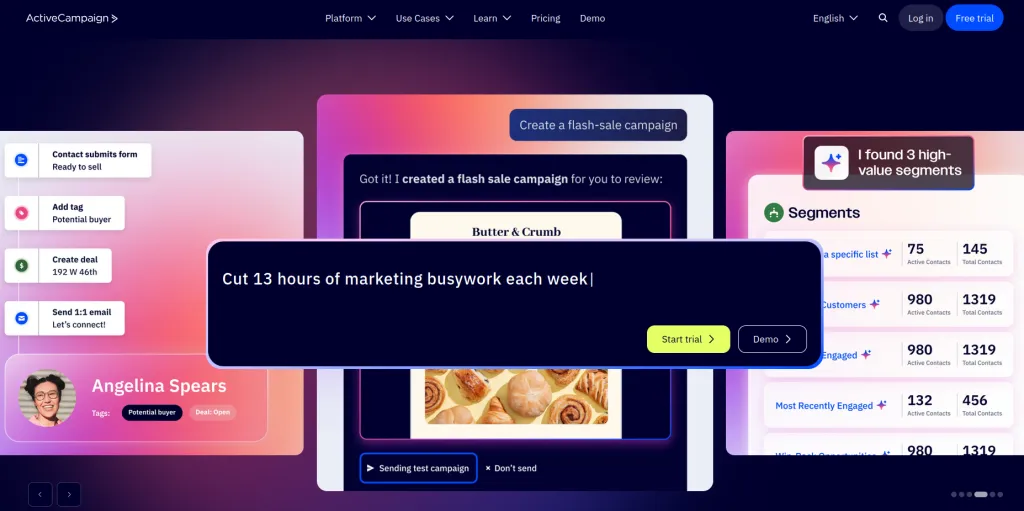
If you work in B2B, SaaS, or anything with a longer sales cycle, ActiveCampaign is probably the most powerful AI email marketing tool in this list for your specific situation.
It’s built around decision-making, specifically the question of who gets follow-up, when, and through what channel.
Key Features:
- Win probability scoring
- Predictive email sending
- AI workflow builder
- CRM with deal tracking
- Lead scoring
- Conditional content blocks
- Sales and marketing alignment tools
Pros and Cons:
| Pros | Cons |
|
|
Best For: SaaS companies, consultants, online educators, and B2B teams where routing the right lead to the right sequence matters.
Pricing Plan: Starter plan from around $15/month, but the real AI features live in the Plus plan at around $59/month. Most serious users end up on Plus or higher.
4. GetResponse
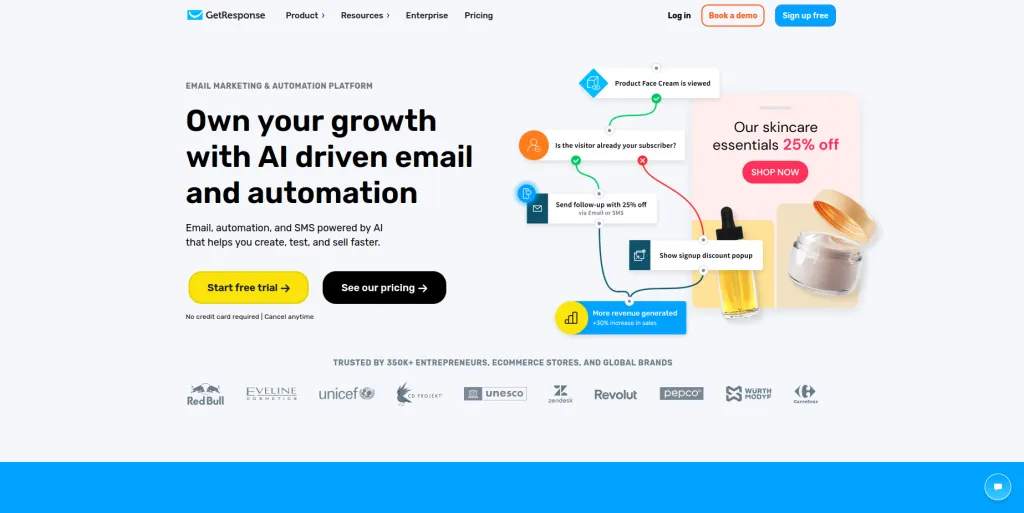
GetResponse sits in an interesting spot. It’s one of those AI email marketing tools that genuinely tries to be an all-in-one platform, and it pulls it off better than most.
You get email, automation, landing pages, webinars, and an AI email generator under one roof. For teams who are tired of juggling five different subscriptions, that’s actually a pretty attractive pitch.
Key Features:
- AI email generator
- Automated sales funnel
- Web push notifications
- Landing page builder
- Webinar hosting
- E-commerce integrations
- AI subject line recommendations
Pros and Cons:
| Pros | Cons |
|
|
Best For: Small to mid-size marketing teams who want email, funnels, and landing pages without paying for five separate tools.
Pricing Plan:
Free plan available for up to 500 contacts. An email marketing plan starts around $19/month. The Marketing Automation and eCommerce Marketing plans unlock the more advanced AI features.
5. Omnisend
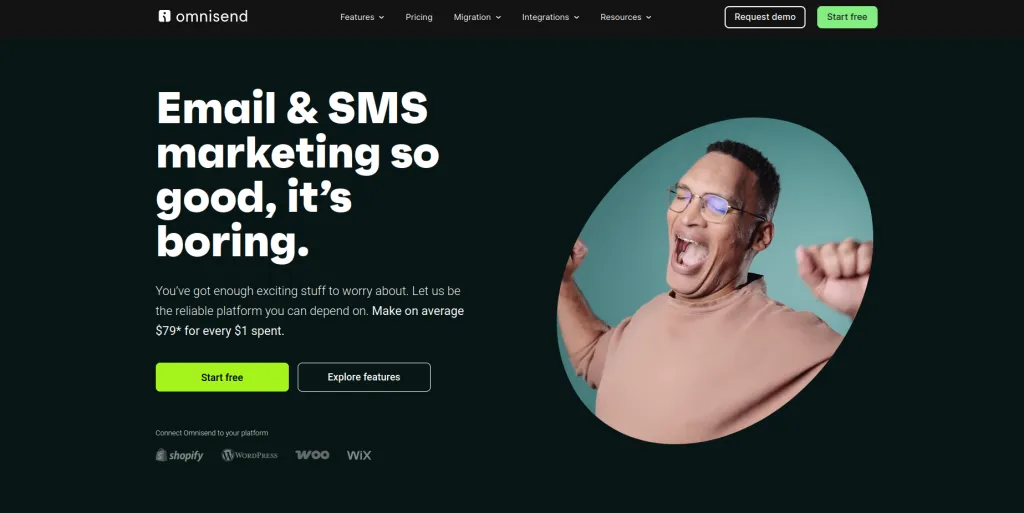
Omnisend is what happens when someone builds an email platform specifically for eCommerce and refuses to add unnecessary complexity.
It’s opinionated by design. The idea is that small store owners should be able to set up powerful automations without needing a dedicated marketing operations person to run things.
Key Features:
- Omnichannel automation (email, SMS, push)
- AI product recommendations
- Pre-built eCommerce workflows
- Lifecycle stage mapping
- Drag-and-drop campaign editor
- Shopify and WooCommerce integrations
- A/B testing
Pros and Cons:
| Pros | Cons |
|
|
Best For: Small eCommerce businesses, Shopify store owners, and lean teams who want powerful AI email marketing tools without the complexity tax.
Pricing Plan:
Free plan available. Pro plan starts around $16/month for up to 500 contacts. Pricing scales with list size, but it stays affordable compared to Klaviyo at similar volumes.
6. Brevo
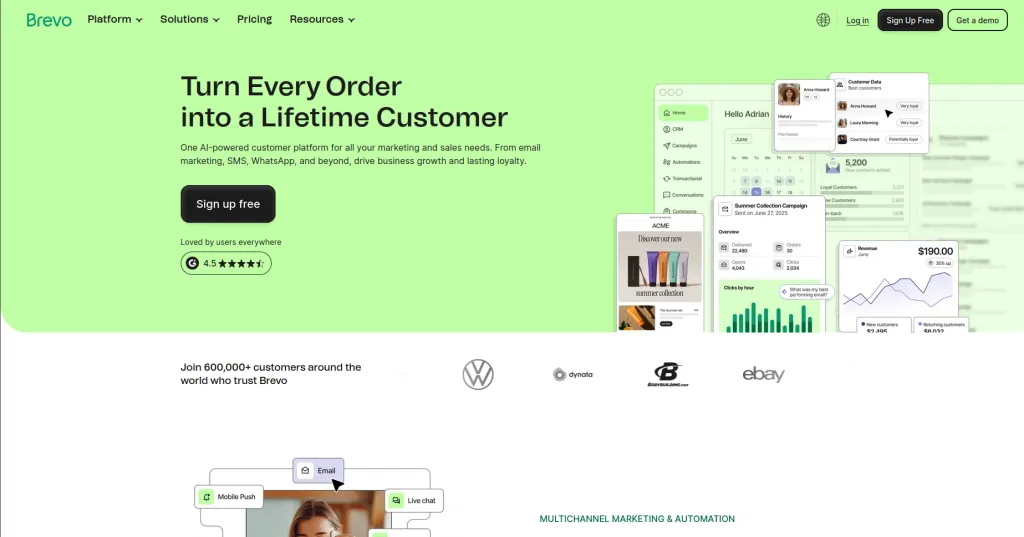
Brevo (formerly Sendinblue) made a smart pivot. While most platforms charge you based on how many contacts you have, Brevo charges based on how many emails you send.
For businesses with large lists but low send frequency, that pricing model alone can save a significant amount of money every month.
Key Features:
- Send time optimization
- AI copy assistant
- Transactional email and SMS
- Marketing automation builder
- CRM built in
- Landing page creator
- Real-time campaign reporting
Pros and Cons:
| Pros | Cons |
|
|
Best For: Media companies, newsletters, businesses with large lists and lower send frequency, and budget-conscious teams who need reliable volume sending.
Pricing Plan:
Free plan includes 300 emails per day. Starter plan from around $25/month. Business plan unlocks automation and AI features at higher price points.
7. ConvertKit (Kit)
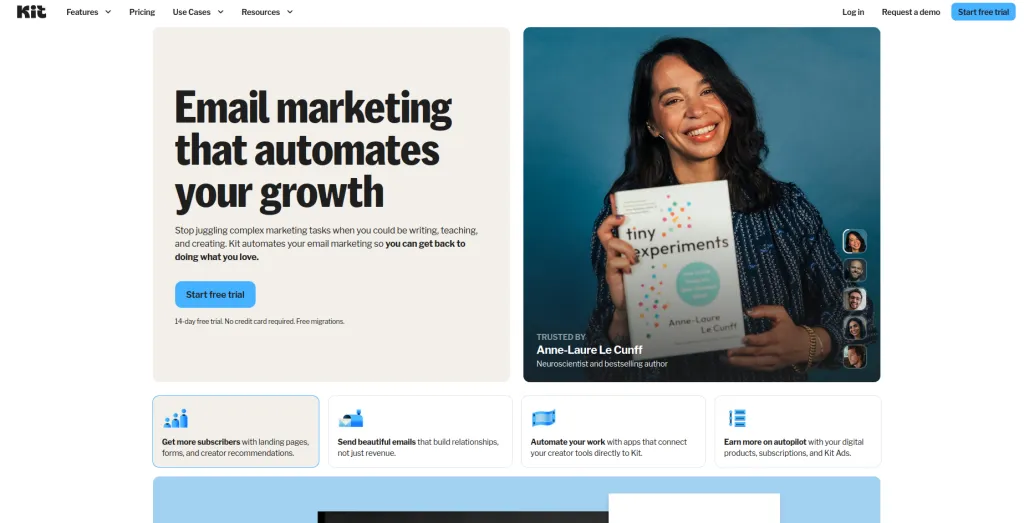
ConvertKit rebranded to Kit recently, and it remains the go-to platform for creators.
If you write a newsletter, run an online course, sell digital products, or build any kind of audience-based business, Kit understands your workflow in a way most other AI email marketing tools simply don’t bother to.
Key Features:
- Visual automation builder
- AI email writing assistant
- Subscriber tagging and segmentation
- Landing page and form builder
- Commerce tools for digital products
- Creator network for cross-promotion
- Deliverability-focused infrastructure
| Pros | Cons |
|
|
Best For: Newsletters, bloggers, course creators, podcasters, and anyone building a direct relationship with their audience through email.
Pricing Plan:
Free plan up to 1,000 subscribers. Creator plan starts around $29/month. Creator Pro unlocks the more advanced features, including subscriber scoring and newsletter referral systems.
How to Choose the Best AI Email Marketing Tools
Picking an email marketing tool feels overwhelming until you stop trying to find the “best” one overall and start looking for the best one for your specific situation. Those are very different searches.
The first thing worth thinking about is what your business actually looks like day to day. An eCommerce store running flash sales and managing repeat buyers has completely different needs from a B2B consultant nurturing a long sales pipeline over several months.
Most of the AI email marketing tools on this list are genuinely excellent, but they’re excellent for different reasons. Klaviyo is extraordinary for product-driven businesses.
ActiveCampaign shines when your sales process involves multiple steps and human touchpoints.
Kit is almost perfectly designed for creators and newsletter writers. Using the wrong tool for your use case is a bit like buying a sports car to move furniture. Technically, it works, but not well.
Budget matters too, though maybe not in the way you’d expect. The cheapest option upfront is rarely the cheapest option six months in.
Some platforms charge by the number of contacts you store, others charge by how many emails you send. If you have a large list but only email them occasionally, a send-based pricing model like Brevo’s can save you real money.
If you email frequently but to a smaller, highly engaged list, contact-based pricing might work out better. Do the math for your actual usage, not a theoretical one.
Lastly, use the free trials. Almost every platform on this list offers one. Don’t just log in and look around. Actually build something.
Set up one automation, create one segment, and send one test campaign. That hands-on time will tell you more about whether a tool fits your workflow than any comparison article ever will.
Wrapping Up!
Honestly, email marketing doesn’t have to feel like a chore you keep pushing to next week. Most businesses are sitting on a goldmine of subscribers they barely know how to talk to, and that’s a shame because those people signed up for a reason.
They wanted to hear from you. The right AI email marketing tools won’t do the thinking for you, but they’ll handle the heavy lifting you’ve been doing manually, and doing badly, let’s be honest.
The timing guesswork, the one-size-fits-all blasts, the automations that haven’t been touched since you built them two years ago. That stuff adds up, and not in a good way.
Pick something from this list that feels manageable for where you are right now. Not the flashiest option. Not the one with the longest feature list.
The one you’ll actually open on a Tuesday afternoon and use properly. Start small, get comfortable, then build from there.
Your subscribers are real people with real inboxes. Treat them that way, give them something worth reading, and send it when they’re actually likely to care.
Do that consistently, and the results tend to take care of themselves. That’s really all there is to it.
Written by
MD Zannatun Nime
February 19, 2026
MD Zannatun Nime writes about WordPress, developer tools, and web design in a simple and easy-to-follow way. He enjoys making complex topics clear, practical, and useful for everyday readers.
Related reading
RESOURCES
WP Smart Pay 3.0 Review: Simple WordPress Payment Plugin for Digital Sales
Building a digital business shouldn't mean wrestling with bloated e-commerce software. In this WP Smart Pay 3.0 review, we explore the visual block builder, client invoicing, recurring billing, in-depth reports, and 25+ integrations.

RESOURCES
7 Best AI Appointment Scheduling Software
Based on our evaluation, Timetics AI is one of the best AI appointment scheduling tools for service-based small businesses. Compare top tools by AI features, pricing, and use cases.

RESOURCES
Best Booking Plugins for WordPress in 2026 – Top Picks for Service Businesses
Discover the best booking plugins for WordPress in 2026. Honest pros, cons & pricing for every top tool. GemBooking leads the list for service businesses.